02 · Electronics & embedded systems
Electronics and embedded engineering, from concept to production-ready hardware.
1722 designs bespoke electronics and embedded systems for hardware and product teams — from requirements and architecture through schematic, PCB and firmware to board bring-up and production-ready hardware. The work spans circuit and PCB design, embedded firmware, power and battery/energy-storage systems, and analogue and precision measurement, applied by a senior engineer directly.
You commission the work, we deliver it, you own it — your design IP is yours.
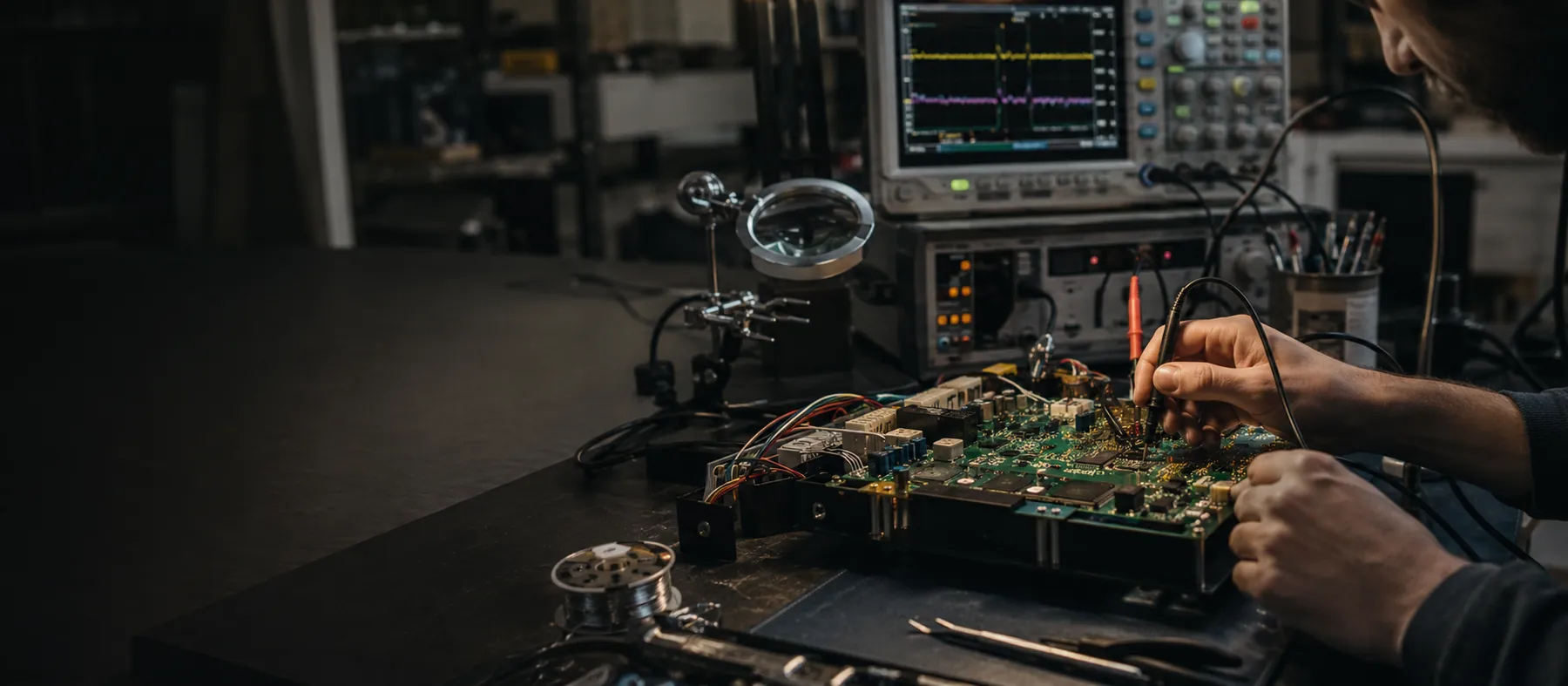
How the work is staged
Five stages. Enter at any point.
A clean-sheet design runs the full path; most engagements start partway through it.
- 01
Requirements & architecture
Capture the requirement, assess feasibility, and set the system architecture before a line is drawn.
- 02
Design (schematic, PCB, firmware)
Schematic capture, PCB layout and firmware architecture developed together, not handed off in sequence.
- 03
Prototype & bring-up
Board build and bring-up — power-up, debug and instrumented checkout against the design intent.
- 04
Design verification
Design verification testing (DVT) and pre-compliance EMC/EMI checks against the requirement.
- 05
DFM & production transfer
Design-for-manufacture review and a documented transfer to your manufacturer and test house.
Enter at any stage — a stalled schematic, a firmware bring-up, or a DFM pass ahead of production are all valid starting points.
What we cover
The disciplines, and where they meet.
Most designs pull on several of these at once — the value is engineering them as one system, not as separate line items.
| Power electronics | DC-DC conversion, power sequencing and protection circuits, supply architecture. |
|---|---|
| Battery & energy-storage systems (BMS) | Battery management, charge and protection circuitry, energy-storage system design. |
| Analogue & precision measurement | Precision analogue front ends, calibration and measurement accuracy. |
| Sensing & signal conditioning | Sensor interfaces, signal conditioning, noise and drift management. |
| Diagnostics & condition monitoring | Instrumentation for condition monitoring and root-cause failure analysis. |
| PCB & circuit | Schematic capture, PCB layout, layer stack and signal-integrity design. |
| Firmware | Drivers, bootloader, RTOS and MCU firmware architecture. |
| Test & validation | Design verification testing (DVT) and pre-compliance EMC/EMI checks. |
What you get
Deliverables you own.
Every engagement ships concrete artefacts your team keeps and can act on — never advice alone.
- Schematics and design-review records
- BOM — bill of materials with component selection and sourcing notes
- Layout & design files — native PCB files, layer stack, fabrication and assembly outputs
- Firmware source — commented and version-controlled, yours to build on
- Bring-up & test notes — board bring-up records and DVT results
- Calculations — power budgets, thermal and tolerance analysis
Out of scope — this is not a productised device, a SaaS platform or a kit; not in-house volume manufacturing (we liaise with your manufacturer and test house for build and formal test); and specific proprietary programmes are described at capability level only, protected by a mutual NDA as standard.
Bring us your design, at any stage.
A short discovery call, then a scoped plan — NDA first if you need one.
FAQ
Electronics & embedded engineering, answered.
Who owns the intellectual property for what you design?
You do. Every engagement is work-for-hire: you commission the work, 1722 delivers the output, and the design IP — schematics, layout, firmware source, calculations — is yours from delivery. There is no licence to negotiate and nothing held back.
Do you sign an NDA?
Yes, as standard. A mutual NDA is offered on every engagement before any design detail changes hands in either direction, protecting your proprietary information and any prior art 1722 brings to the work.
Do you do power and battery work?
Yes. Power electronics, battery and energy-storage systems, and battery management (BMS) design sit alongside analogue and precision measurement, and diagnostics and condition monitoring, as core disciplines.
Do you take a design through to production, or only prototype it?
Both, or either. The journey runs from requirements and architecture through schematic, PCB and firmware design, prototype and bring-up, design verification, and DFM and production transfer. You can commission the whole path or bring 1722 in at a single stage. Volume manufacture itself sits with your manufacturer and test house — 1722 liaises with them directly through transfer, rather than running production in-house.
Can you plug into an existing team mid-project?
Yes. Plugging into an existing programme — reviewing a schematic that has stalled, taking over a firmware bring-up, or running design verification ahead of a deadline — is a common entry point. Scope and deliverables are agreed against where the design already stands.
How do you handle EMC, CE/UKCA and other compliance standards?
As design disciplines, not late-stage tests. EMC/EMI, CE/UKCA, LVD, FCC, UL, IEC 62133 and UN 38.3 are designed to from schematic onward, with pre-compliance checks built into design verification. 1722 does not hold or claim a certification body’s accreditation; formal certification testing is arranged with an accredited test house as part of production transfer.
Who typically commissions this work?
Hardware and product R&D leadership — CTOs, Heads of Engineering, Product/Innovation Directors and R&D or Quality Managers — usually when a design needs senior judgement applied directly, not delegated to a junior bench or a build shop.