01 · Warehouse systems engineering
The engineering behind your warehouse automation.
You already own a WMS and automation. The picks are still slow, the counts are still off, and operators work around the system instead of through it. 1722 is the independent, vendor-neutral engineering that makes the systems you own perform — configuration, integration, commissioning and analytics, scoped as a project, not sold as a product.
We engineer the WMS and automation you already own to perform — independent, with no platform or kit to sell you.
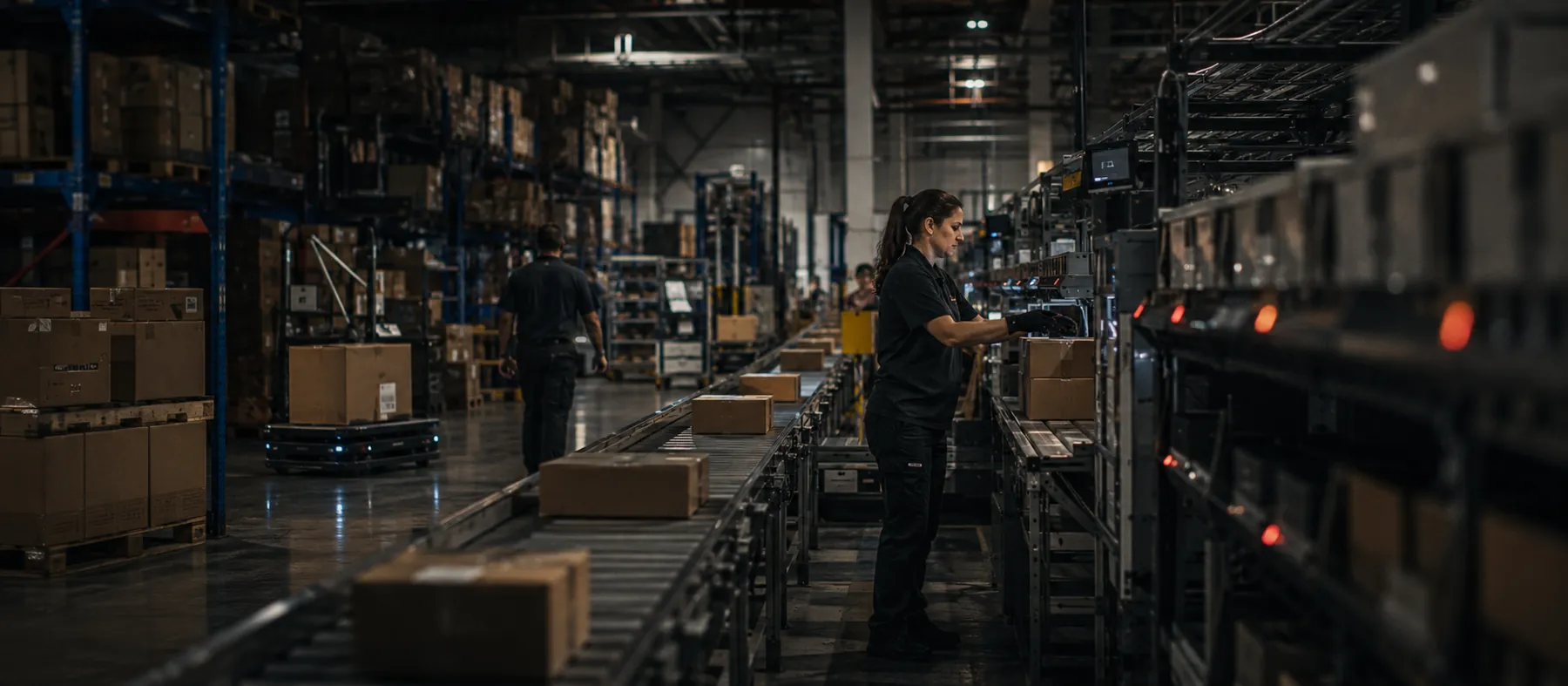
What we engineer
Four buyer jobs, one senior engineer.
The four things warehouse operators actually need engineered — each available on its own or as one staged programme.
- 01
WMS configuration & optimisation
Align the WMS to how your floor really works: pick and put path design, slotting, wave planning, directed put-away, allocation, batching, replenishment and returns.
WMS optimisation - 02
Automation integration & commissioning
Pick-to-light, put-walls, conveyor/sortation and materials-handling controls, plus WES/WCS: configuration, installation coordination, controls commissioning, testing and go-live.
Automation integration - 03
Launch, migration & stabilisation
Go-live readiness, cutover and post-go-live optimisation — the difference between a launch that limps and one that holds throughput from day one.
- 04
Warehouse data & analytics engineering
Custom ETL, exception/DPMO logic and labour, productivity and inventory-accuracy dashboards on your own WMS — built to be used on shift, not filed away.
Warehouse analytics
What you get
Deliverables you own.
Every engagement ships concrete artefacts your team keeps and can act on — never advice alone.
- KPI baseline across receiving, put-away, picking, staging and shipping, with the current-state read
- Configuration & process design — documented WMS configuration aligned to the floor
- Integration & commissioning records — controls, test results and go-live sign-off
- Analytics & dashboards — the queries, logic and on-shift views, on your own stack
- Go-live & cutover plan with readiness criteria and rollback
- Handover pack — documentation and training so your team runs it without us
How the work is staged
A project, not a ticket queue.
| 1 · Assess | Warehouse walk & KPI baseline across the flow. ~2 weeks |
|---|---|
| 2 · Design & configure | WMS configuration and integration aligned to documented processes. 8–12 weeks |
| 3 · Commission & assure | Controls commissioning, testing, go-live readiness. ~2 weeks |
| 4 · Stabilise & adopt | Post-go-live optimisation, documentation, training. ~2 weeks |
Out of scope — we do not sell a WMS or automation product, resell hardware or take vendor commissions, and we do not run day-to-day operations, monitoring or a helpdesk. Post-go-live support is an optional follow-on, never a lock-in.
Your systems, engineered to perform.
Tell us where the floor is fighting the system. A short discovery call, then a scoped plan.
FAQ
Warehouse engineering, answered.
Do you sell a WMS or automation hardware?
No. We do not sell a WMS, automation hardware, software licences or 3PL capacity, and we take no vendor commissions. We engineer the systems you already own to perform. That independence is the point — our recommendations follow your floor, not a product line.
How is this different from what a WMS vendor or a product company offers?
A WMS vendor configures you onto their platform; a product company sells you a tool you configure yourself. We are the vendor-neutral engineering in between and behind them — aligning the WMS you run to how your floor actually works, integrating and commissioning the automation you have chosen, and building analytics on your own data. It is bespoke engineering time, not a product or a subscription.
What does a typical engagement look like?
A staged, fixed-scope project rather than a managed-services contract: a discovery phase with a warehouse walk and KPI baseline (~2 weeks), an execution phase of configuration and integration (typically 8–12 weeks), system assurance and go-live (~2 weeks), then adoption support (~2 weeks). A full warehouse systems engagement is typically scoped at 14–18 weeks; smaller work packages are scoped accordingly.
Which WMS platforms do you work with?
Vendor-neutral by design — the method is platform-independent. Engagements begin from how your floor runs and what your WMS and automation can do, not from a single vendor’s playbook. Tell us what you run on the discovery call and we will be specific about fit.
Can you help with warehouse reporting and dashboards?
Yes — as bespoke engineering on your own systems: custom ETL, exception and DPMO logic, and labour/productivity and inventory-accuracy dashboards built to be used on shift, not filed in a shared drive. It is one-off engineering on your stack, not a productised analytics subscription.
Do you run our operations afterwards?
No. This is project engineering with a defined go-live and end point, not ongoing operations. We hand over documentation and train your team so you own it. Post-go-live optimisation or a light retainer is available as a follow-on, but it is never the lead offer and never a lock-in.
Who typically brings us in?
Operations and supply-chain-technology leadership at 3PLs and warehouse operators — VP/Director of Operations, VP/Director of Supply Chain Technology, Operations Managers and WMS/solutions engineers — usually when the floor still fights slow picks, inaccurate counts, congested aisles or aging exceptions despite already owning the systems.